
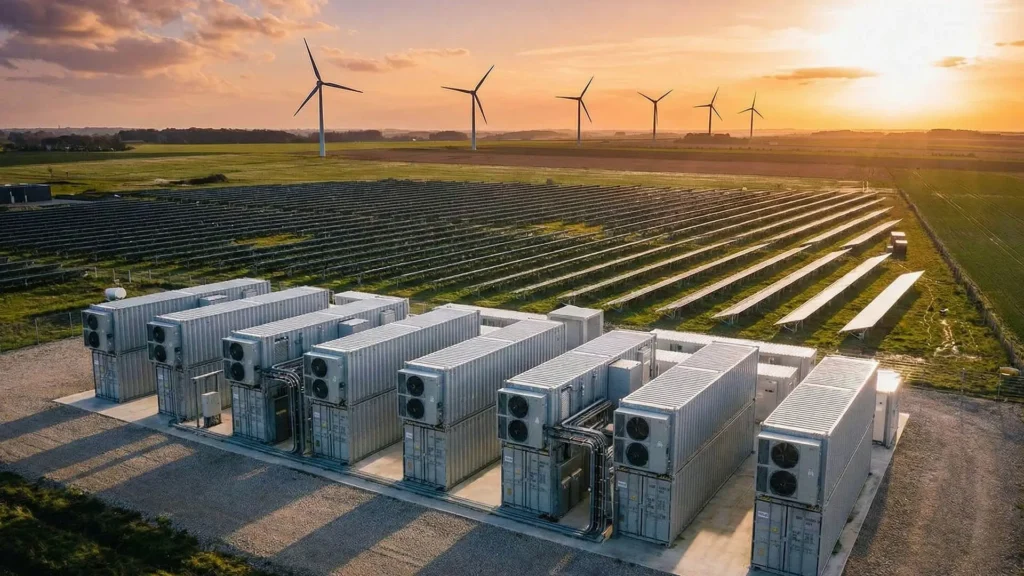
The first phase of the renewable energy transition was driven by a single objective: generation. The priority was to demonstrate that renewable technologies such as solar and wind could operate at scale and compete with conventional energy sources on cost and reliability. That phase has largely been resolved.
The energy transition is now entering a more sophisticated stage. Attention has shifted from pure generation toward stability, optimisation, and system resilience.
For institutional investors and family offices, the central question is no longer whether renewables will dominate future energy systems, but how value is created within an increasingly complex and interconnected grid environment.
At Solar45, we believe this next phase is defined not by individual technologies in isolation, but by their strategic integration. Our approach focuses on the convergence of solar generation, energy storage, and complementary renewable assets, positioning portfolios within the most structurally relevant segment of modern energy infrastructure.
This integrated approach represents what we describe as the “smarter slice” of the energy market.
1. Solar PV as the Structural Foundation
Solar photovoltaic generation remains the core foundation of renewable energy infrastructure. It is a predictable and scalable source of power, with well-understood performance characteristics and a mature regulatory framework.
Portugal plays a central role in this strategy. The rationale is practical rather than ideological. The country benefits from some of the highest solar irradiance levels in Europe, alongside established grid infrastructure and an increasingly supportive regulatory environment. These conditions allow solar assets to progress through development stages with a higher degree of visibility and consistency.
Our focus is on mid-stage development, advancing projects from secured land positions and defined grid access toward Ready-to-Build status. This stage of the lifecycle allows value to be structured through planning, permitting, and technical optimisation, while avoiding the uncertainty associated with early-stage site origination.
Solar’s limitations are well understood. Generation is inherently intermittent, with output concentrated during daylight hours. In earlier phases of the transition, this characteristic was viewed as a constraint. In the current market, it has become a catalyst for structural innovation.
2. Battery Energy Storage as an Enabling Layer
Battery Energy Storage Systems (BESS) have become a critical component of modern energy infrastructure. Their role is not simply additive, but transformational.
When integrated with solar generation, storage converts intermittent production into a controllable energy resource. Assets are no longer limited to producing power when conditions allow; they can actively participate in grid management and optimisation.
From a system perspective, BESS introduces several structural advantages:
- Grid Stability: Storage assets can respond rapidly to fluctuations in supply and demand, supporting voltage and frequency management within increasingly decentralised grids.
- Temporal Optimisation: Excess energy generated during periods of high supply can be stored and released during periods of higher demand, aligning production with consumption patterns.
- Volatility Management: Storage enables participation across multiple grid services, reducing exposure to single-price dynamics.
Through this integration, energy assets evolve from passive generators into active infrastructure components. The combination of solar and storage reflects a shift from energy production toward energy system participation.
3. Wind as a Complementary System Component
While Solar45’s current focus is weighted toward solar and storage assets, wind energy remains an essential element of the broader renewable ecosystem.
Wind generation profiles often differ materially from solar, with stronger output during evening hours or seasonal periods when solar generation is lower. In diversified energy systems, this natural complementarity contributes to a more balanced and resilient supply profile.
Understanding how wind, solar, and storage interact at a system level is increasingly important for investors evaluating long-term infrastructure themes. The value lies not only in individual assets, but in how portfolios align with the evolving needs of modern grids.
The Solar45 Infrastructure Thesis
Solar45 builds on development discipline established in prior strategies, applying that experience to a more integrated and system-aware approach.
By concentrating on defined development stages and prioritising assets that align with grid evolution, the strategy focuses on creating infrastructure that is relevant to how energy markets now operate, rather than how they operated in the past.
The integration of generation and storage is not a thematic overlay. It is a structural response to how value is now created within energy systems. This technological and strategic alignment forms the core of the Solar45 thesis.
The result is an approach centred not simply on renewable energy, but on intelligent energy infrastructure designed for the next phase of the transition.
Solar45 Series 1 is available to professional investors only. Capital is at risk. Terms and conditions apply. Further information is available via the Private Placement Memorandum.