
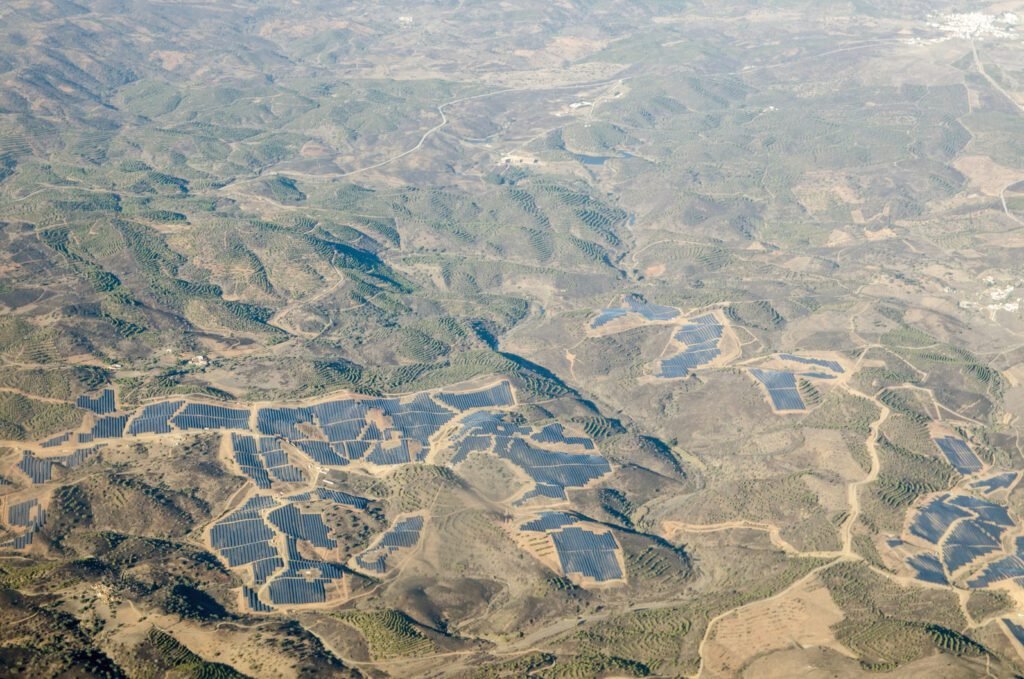
A completed solar farm is, in most respects, a commodity. The panels come from a small number of manufacturers, the engineering has been refined over two decades, and the sunlight falls equally on every field in the region. What is not a commodity is everything that has to happen before the first panel goes in: planning consent, a grid connection agreement, and a site where the network can actually take the power. Those take years to secure, and most proposed projects never get them.
That gap is where Solar45 works. Our focus is solar development in Portugal at the early stage, advancing projects toward Ready to Build status with battery storage built into the design from the outset rather than added later.
Generation is the easy part now. Permission, connection and position are the scarce ones.
Why early stage rather than operating assets
An operating solar farm is a known quantity. It has a production record, a revenue history and a price that reflects both. Buyers of operating assets compete with pension funds and infrastructure managers that have a lower cost of capital, which leaves little for anyone arriving late. The competition is intense precisely because the uncertainty has already been removed.
Development stage assets sit at the other end of that curve. The uncertainty is real, and so is the work required to remove it. A site has to be assessed, secured, taken through planning and connected to a grid that, in much of Europe, is already close to full. Each milestone cleared changes what the asset is worth, because it moves the project closer to the point where institutional capital will underwrite it. The value comes from the process, not from the weather.
Why Portugal
Portugal combines three things that rarely appear together. Its solar resource is among the strongest in Europe, with irradiance well above northern markets. Its regulatory framework has been built steadily since the early 2000s and has held across governments of different parties. And it has already proved the economics at auction, contracting solar at some of the lowest prices recorded anywhere.
The policy direction is clear as well. Portugal now has explicit battery storage targets and a recurring auction for grid capacity, which we cover in what Portugal’s energy storage strategy means for Santa Marta and Baloiço. Land is part of the story too: dry, hard to farm ground in the south is gaining value as solar sites, as set out in why low productivity land suits solar in Portugal.
Why storage is part of the design, not an addition
A solar asset that can only sell power at the moment it generates is exposed to the hours when every other solar asset is generating too. In markets with heavy solar build out, midday prices fall sharply and at times turn negative. Storage moves that energy through time, so the asset can sell into the evening when demand and prices rise, and earn from the balancing services the grid needs.
Designing storage in from the start matters more than it sounds. A battery placed at a solar connection that already exists avoids most of the queue and much of the cost a stand alone battery would face. Adding it later can mean rejoining a connection queue that runs for years in several markets. That logic sits behind both Solar45 projects: Santa Marta, with 200MW of solar and potential for 600MWh of storage, and Project Baloiço, a dedicated battery storage asset.
What Ready to Build actually means
Ready to Build is the point at which a project has everything it needs to start construction: consents in place, grid connection secured, land rights settled and commercial arrangements documented. It is also the point at which the pool of buyers changes. Institutional capital that will not take planning risk will underwrite a permitted, connected asset.
The Solar45 strategy targets that transition. Capital enters while development work is still under way, and each project is positioned for an institutional exit once it reaches Ready to Build. None of that is guaranteed. Projects can stall in planning, grid offers can be delayed or refused, and timelines slip routinely across the sector. Santa Marta’s path since 2019 shows how long this can take, as we explain in Santa Marta: what patience looks like in a solar development.
The honest reading
Early stage development carries real risk, and it is a different risk from the one an operating asset carries. Planning can be refused. A grid connection can arrive late or not at all. Capital committed at this stage is at risk for the full term, and where an investment is asset backed, that backing does not guarantee the return of capital.
What the stage offers in exchange is a position taken before the uncertainty has been priced out by everyone else. Whether that trade suits a particular portfolio depends on the investor’s time horizon, their need for liquidity and how the position sits alongside everything else they hold.
For certified high net worth individuals, sophisticated investors and investment professionals only. Not for retail investors. Solar45 is not authorised or regulated by the FCA, and the investments referred to are unregulated. This is not financial advice or an offer. Capital is at risk, investments may be illiquid, and past performance is not a reliable indicator of future results. Seek independent advice before investing. See our Legal Notice.
